Asphalt Patching & Pothole Repair in Jackson, MS
Commercial asphalt patching and pothole repair in the Jackson, MS metro. Patches that fix the cause, not just the hole. Free on-site quotes.
Commercial asphalt patching and pothole repair in Jackson, MS
A pothole is the visible end of a problem that started underground. Water got into the base, the base lost strength, traffic worked the weakened area, and the surface finally gave way. That is why filling the hole with cold patch out of a bag and rolling over it with a truck tire does not hold: nothing about the cause changed.
Pinnacle Pavement Services repairs commercial asphalt across the Jackson metro: Jackson, Madison, Ridgeland, Flowood, Pearl, Brandon, Clinton, Byram, Richland, and Canton. We also serve east central Mississippi: Carthage in Leake County, Kosciusko in Attala County, Philadelphia in Neshoba County, and Forest in Scott County. Retail centers, churches, apartment communities, medical offices, schools, truck and equipment yards, and industrial properties. We are a pavement maintenance specialist. We fix and protect the asphalt you have, and when a lot genuinely needs full replacement we say so instead of selling you patches forever.
The real cost of an open pothole
A pothole in a commercial lot is a liability item before it is a maintenance item. Trip and fall claims, wheel and suspension damage claims, and the insurance conversation that follows all cost more than the repair did. For a property manager, it is also the single most visible signal to a tenant that the property is not being looked after, and it tends to come up right around lease renewal.
There is a compounding cost too. An open pothole is a water entry point. Every rain sends more water into the base around it, which widens the failure area. A repair that is a two-foot square this spring is a six-foot square next spring, and the price scales with the area.
How we actually repair it
We scope the repair to the failure, not to a price sheet:
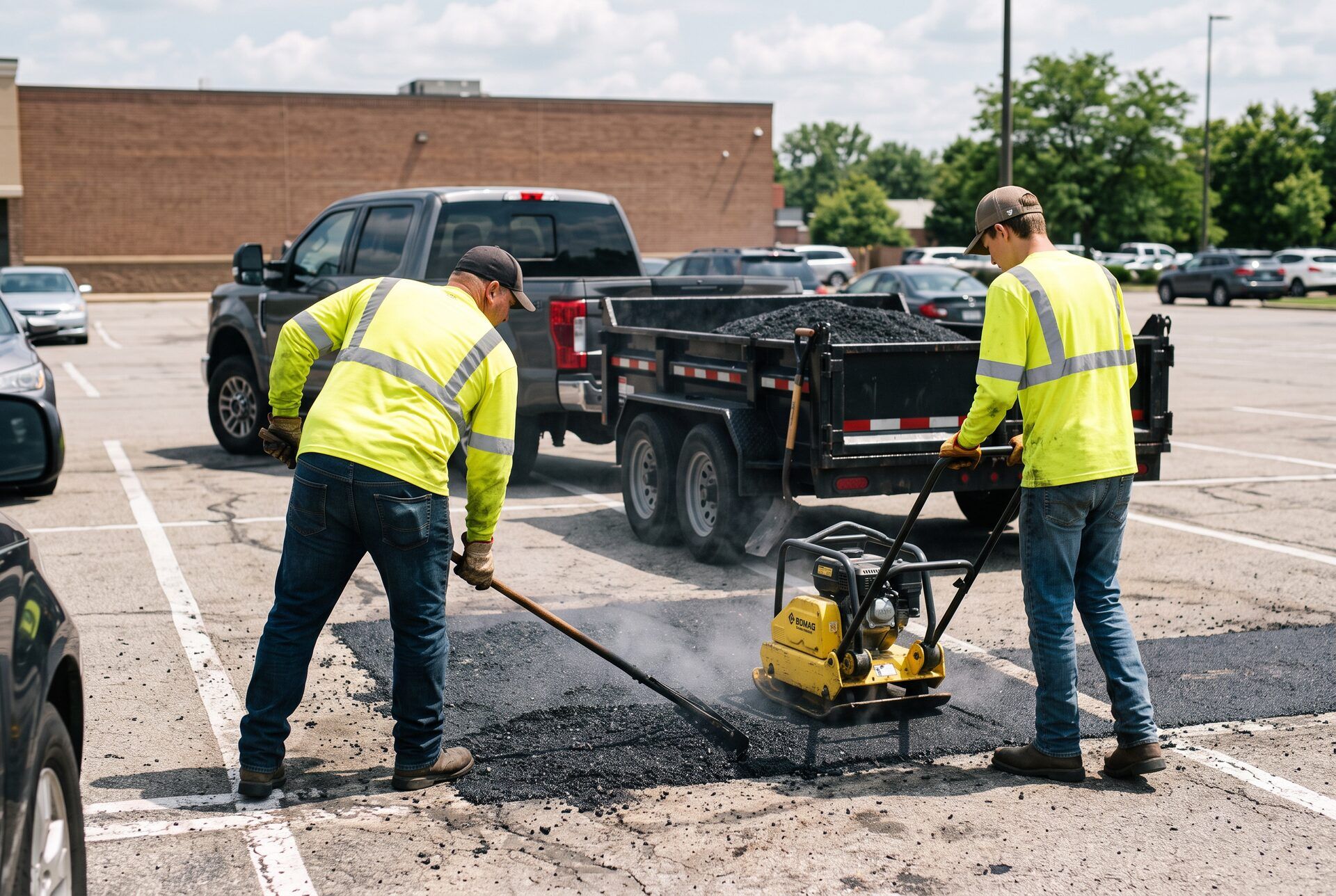
Surface patching. When the base is sound and the damage is confined to the top layer, we saw-cut a clean edge around the failed area, remove the deteriorated asphalt, tack the exposed edges so the new material bonds instead of separating, place hot mix, and compact it. Clean square edges matter: a ragged patch edge is the first place the repair fails.
Full-depth patching. When the base has failed, and in a lot with recurring potholes it usually has, surface work is wasted money. We cut out the full section, excavate the failed base material, rebuild with properly graded aggregate, compact it in lifts, then pave and compact the asphalt back to grade. This is the repair that lasts, and it is the one we recommend when the conditions call for it.
Infrared repair is available for certain seamless surface repairs where reheating and reworking the existing asphalt is appropriate, which avoids a cold joint around the patch.
Drainage. If water is pooling in the same place every time it rains, the patch will fail again no matter how well it is placed. We flag standing-water areas, low spots, and failing drainage during the walk-through so you know what is driving the failure.
Patching is step one, not the whole job
Patching stops the failure. It does not stop the next one. The properties that quit having pothole problems are the ones that pair patching with the rest of the maintenance cycle:
- Patch the failed areas so the base stops taking on water there
- Crack seal the working cracks so water has no other route in
- Sealcoat to protect the surface from UV, oxidation, and moisture
- Restripe so the lot looks maintained and traffic flows where the pavement can take it
Run on a sensible cycle, that program costs a fraction of what reconstruction costs and routinely adds a decade of serviceable life. Skip it and you are buying patches indefinitely until the lot fails all at once.
Where potholes show up first in the Jackson metro
Failure is not random. On the lots we work in central Mississippi, the pattern is consistent. Entrances and exits, where vehicles decelerate and turn under load, go first. Drive lanes and turning radii follow, especially anywhere trucks track the same path. Dumpster pads take a beating from the front axle load of a loaded truck plus the hydraulic lift. Low spots that hold water after every rain fail from underneath. And any area with a previous throw-and-go patch tends to fail again around the patch edges.
Yazoo clay is a real factor here. The expansive clay under much of the metro moves seasonally, which works cracks open and puts stress on pavement that would sit still in another part of the country. Combine that with more than fifty inches of rain a year and pavement that never gets sealed, and you get the exact failure pattern we are called out to fix.
What patching costs
Patching is priced by the square footage of the repair, the depth required, the number of separate repair areas, and access. Two things move the number the most. Full-depth costs more than surface, because there is excavation, aggregate, and compaction involved. And mobilization is a fixed cost, so five small repairs on one visit are far cheaper per repair than five separate trips.
That is the practical advice we give every property manager: batch the repairs. If you have a list of failures across a property, or several properties in the metro, doing them in one mobilization is the biggest single lever on the price.
Every quote is a firm written number after we measure on site, with the surface-versus-full-depth call made in front of you and explained.
When we tell you not to patch
If a large share of your lot has base failure, patching is not the honest recommendation. At that point you are paying maintenance prices repeatedly for a result that will not hold, and an overlay or full reconstruction is the right call. We do not do new paving or replacement, which means we have nothing to gain by telling you that. We will tell you anyway, point you toward getting it bid properly, and be here to maintain it once it is down.
Frequently asked questions
Why do my potholes keep coming back?
Because the patch treated the hole and not the cause. A pothole is a symptom of water in the base. If the failed material is not cut out to sound pavement, the base is not compacted, and the water source is not addressed, the new patch fails on the same schedule as the old one. Throw-and-go cold patch in particular is a temporary measure, not a repair.
What is the difference between a surface patch and a full-depth patch?
A surface patch replaces the top layer where the asphalt has raveled or cracked but the base underneath is still sound. A full-depth patch removes everything down through the failed base, rebuilds and compacts the base, then repaves. Surface patching is cheaper and correct when the base is good. Full-depth is the only thing that lasts when the base has failed, and using the cheap option there just buys a repeat visit.
Can you repair potholes in winter, or do I have to wait?
Central Mississippi winters are mild enough that hot-mix work is usually possible on dry days most of the year. In genuinely bad weather we can place a high-quality temporary patch to remove the trip and tire hazard immediately, then come back and do the permanent repair when conditions allow. We will tell you which one you are getting.
How long does the area need to stay closed?
Most patches take vehicle traffic within a few hours of placement and compaction, and small repairs are often same-day in and out. We barricade the work area, phase larger repairs so the rest of the lot stays open, and plan the timing with you when a daytime closure would cost you business.
Is patching worth it, or should I just replace the lot?
It depends on how much of the lot has failed. When failures are isolated, patching plus crack sealing and sealcoating is dramatically cheaper and buys years. When a large share of the lot has base failure, patching becomes throwing money at a lost cause and an overlay or reconstruction is the honest answer. We do maintenance, not new paving, so we have no reason to tell you the expensive answer when it is not true, and we will say so plainly when your lot has passed that point.
Patching & Pothole Repair across the Jackson metro
Available in every city we serve.