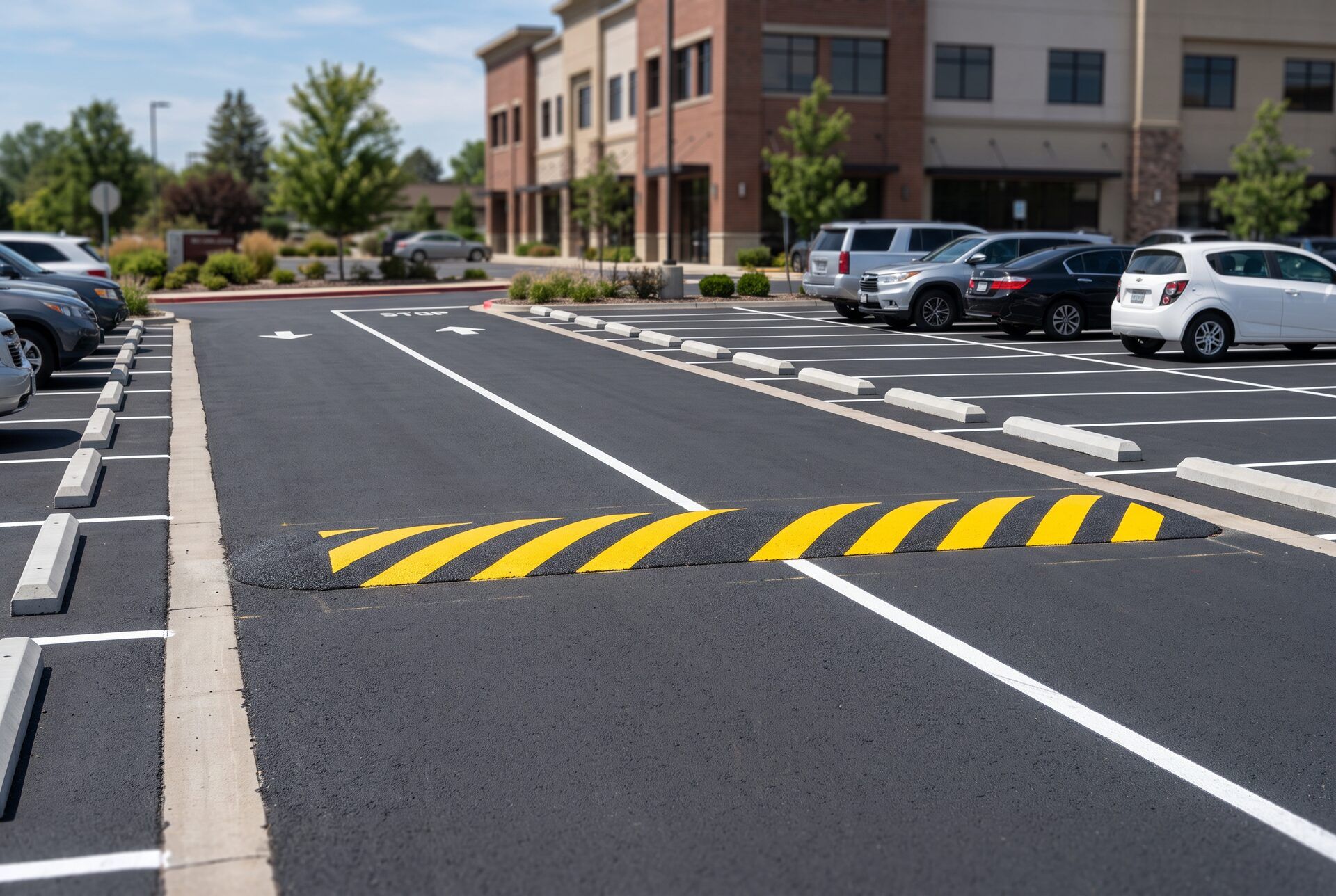
Wheel Stops, Speed Bumps & Bollards in Jackson, MS
Wheel stop, speed bump, and bollard installation for commercial lots in the Jackson, MS metro. Traffic control that protects your property. Free quotes.
Wheel stops, speed bumps, and bollards in Jackson, MS
Traffic control hardware is the least glamorous part of a parking lot and one of the highest-return. Wheel stops keep vehicles off sidewalks and away from building faces. Speed bumps and humps slow drivers before they hurt someone. Bollards stand between a distracted driver and your storefront glass, your gas meter, or your propane cage.
Pinnacle Pavement Services installs and replaces this hardware across the Jackson metro: Jackson, Madison, Ridgeland, Flowood, Pearl, Brandon, Clinton, Byram, Richland, and Canton. We also serve east central Mississippi: Carthage in Leake County, Kosciusko in Attala County, Philadelphia in Neshoba County, and Forest in Scott County. Retail centers, apartment communities, churches, schools, medical offices, warehouses, and industrial yards.
Wheel stops
A wheel stop, sometimes called a parking block or curb stop, does three things: it stops vehicles from overhanging a sidewalk and blocking the pedestrian route, it protects the building face and storefront glass from bumper contact, and it holds the parking layout so vehicles sit where the stall was designed for them.
That third one matters more than people expect. In lots without stops, vehicles creep forward over time, which narrows the drive lane behind them and makes the lot feel tighter than it is. On a lot where the accessible route runs along a sidewalk, an overhanging bumper is also an accessibility problem, because it blocks the route you are required to keep clear.
We install both concrete and recycled rubber stops, anchored with pins or bolts sized to the surface. Rubber is our default for most commercial lots: lighter, impact tolerant, will not spall, and easy to lift for sealcoating and restriping. Concrete is the right call in heavy-vehicle areas where mass matters.
Old, broken, and half-anchored stops are a trip hazard and read as neglect. If yours are cracked into pieces or drifting out of position, replacement is inexpensive and immediately visible.
Speed bumps and speed humps
Choosing between them is the whole job:
- Speed bumps are short, abrupt, and drop vehicles to a near stop. Correct at pedestrian crossings, structure entrances, tight service areas, and anywhere you need drivers fully slowed.
- Speed humps are longer and gentler and hold traffic to a moderate speed without jarring vehicles. Correct for apartment community streets, long drive lanes, campus roads, and anywhere you want flow rather than a stop.
Putting a bump where a hump belongs produces exactly what you would expect: complaints, vehicles swerving around it onto the landscaping, and drivers braking hard at the same spot until the pavement there starts to fail.
Placement matters as much as type. We set them where drivers have sight distance to react, where the pavement underneath is sound, and never in a low spot where they will dam water. Every one gets striped and, where appropriate, signed, because an unmarked bump at night is a claim waiting to happen.
We install rubber and asphalt speed bumps and humps, and we restripe existing ones that have gone invisible.
Bollards
Bollards are the cheapest insurance on a commercial property. A vehicle into a storefront is a glass claim, an inventory claim, a business interruption, and potentially an injury. A vehicle into a gas meter is considerably worse.
We install and replace bollards at storefronts and glass frontage, building corners and columns, gas meters, utility pedestals and transformers, propane and cylinder cages, dumpster enclosures, drive-through equipment, and pedestrian walkway ends. We also repaint and re-sleeve existing bollards, which is often all that is needed. A rusted, faded bollard is not doing its visibility job even if it is still structurally fine.
The rest of the traffic package
While we are on site we also handle the markings that make traffic control actually work: directional arrows and one-way markings, stop bars and STOP legends, crosswalks and pedestrian routes, loading zone and no-parking markings, EV charging and reserved stall markings, and signage posts.
Hardware without markings underperforms. Drivers follow paint.
Bundle it with the pavement work
This is the clearest bundling case on the whole site. Wheel stops have to come off for sealcoating and restriping anyway. Speed bumps and humps have to be striped after sealcoat. Bollard bases sit in the area being sealed.
Doing hardware as its own visit means paying mobilization for a job that is mostly labor-minutes. Doing it inside a sealcoat and stripe package means the crew pulls the stops, seals the lot, resets everything on the fresh layout, and stripes the bumps in one pass.
What it costs in the Jackson metro
Wheel stops are priced per unit installed, with material choice and anchoring driving the number. Speed bumps and humps are priced per unit by length and type. Bollards are priced per unit by diameter, depth of set, and whether the base is asphalt or concrete. Repainting existing bollards is priced per unit and is much cheaper than replacement.
Across all of it, mobilization is the fixed cost, so quantity and bundling drive the per-unit price down fast. A property replacing forty wheel stops pays far less per stop than one replacing four.
Every quote is a firm written number after an on-site count and measurement, and if your existing hardware only needs repainting or re-anchoring we will tell you that rather than quoting replacement.
Frequently asked questions
What is the difference between a speed bump and a speed hump?
A speed bump is short and abrupt and drops vehicles to a crawl, which suits tight areas like a parking structure entrance or a pedestrian crossing. A speed hump is longer and gentler and slows traffic to a moderate speed without jarring vehicles, which suits drive lanes and apartment community streets where you want flow, not a full stop. Choosing the wrong one is the most common mistake we get called to fix.
Are rubber or concrete wheel stops better?
Concrete is more durable and heavier, so it stays put, but it cracks when struck hard and is heavier to replace. Recycled rubber is lighter, more forgiving on impact, will not spall, and is easier to remove for sealcoating and restriping. For most commercial lots we recommend rubber, and for heavy-vehicle areas we recommend concrete. We will make the call based on what parks there.
Will speed bumps hurt my asphalt?
A properly installed one will not. A badly installed one will, because vehicles braking and accelerating at the same point concentrate stress. We place them where the pavement is sound, anchor them correctly, and stripe them so drivers see them and slow gradually instead of braking hard at the last second.
Do wheel stops need to be removed for sealcoating?
They should be. Sealcoating around a wheel stop leaves an unsealed strip and a visible line where the stop sat, and the same applies to restriping. We pull them, do the pavement work, and reset them on the fresh layout. It is one of the reasons bundling this with a sealcoat visit makes sense.
Can you install bollards to protect a storefront?
Yes. Bollards in front of glass storefronts, at building corners, around utility meters and gas lines, and beside dumpster enclosures are one of the highest-value items in a parking lot. A single vehicle-into-storefront incident costs far more than protecting the frontage.
Wheel Stops & Speed Bumps across the Jackson metro
Available in every city we serve.